
A Technical Data Sheet (TDS) describes the coating's technical properties, preparation and application requirements. A Safety Data Sheet (SDS) provides chemical hazard, handling and emergency information. Buyers of metal and floor coatings use these documents together to verify the supplied product, prepare application instructions and organise safe handling. The product code, individual components, document revision and country of use are the key details to match before purchase.
TDS vs SDS: which document answers each question?
| Buyer question | TDS | SDS |
|---|---|---|
| Where can the product be used? | Intended application, compatible substrates and coating layers | Product identification and applicable use restrictions |
| How much material is needed? | Coverage, consumption, thickness and related conditions | — |
| How is the coating applied? | Mixing ratio, preparation, method, pot life and recoating | Handling, exposure controls and protective measures |
| What are the chemical hazards? | Technical product properties | Hazard classification, precautions and relevant composition information |
| How is the material stored? | Recommended storage and shelf life | Safe storage conditions and incompatibilities |
| What happens during a spill or exposure? | — | First aid, spill response and firefighting information |
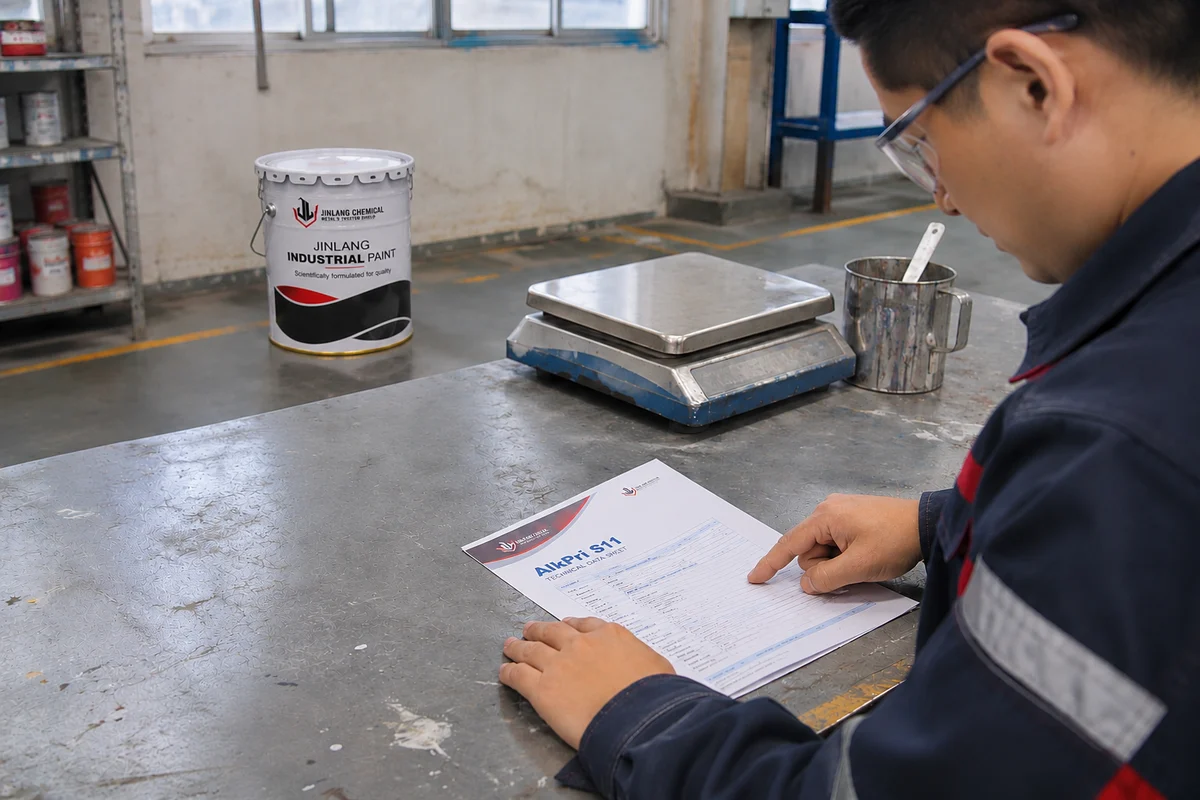
A purchasing record should connect the quotation, product labels and the corresponding documents. This gives procurement, warehouse and application teams the same product information.
Match the product code, components and revision
For a one-component (1K) coating, identify the product and its corresponding technical and safety documents. For a two-component (2K) coating, match the base, curing component and any separately supplied thinner or cleaner.
| Supplied material | Technical information | Safety information | Identity to match |
|---|---|---|---|
| 1K coating | Product TDS | Product SDS | Product name and code |
| 2K coating, Part A | TDS covering the specified A+B combination | Part A SDS | Base product and component code |
| 2K coating, Part B | Matching A+B TDS | Part B SDS | Curing component and code |
| Thinner | Compatible use and permitted addition in coating instructions | Thinner SDS | Thinner name and code |
| Separately supplied cleaner | Applicable use instructions | Cleaner SDS | Cleaner name and code |
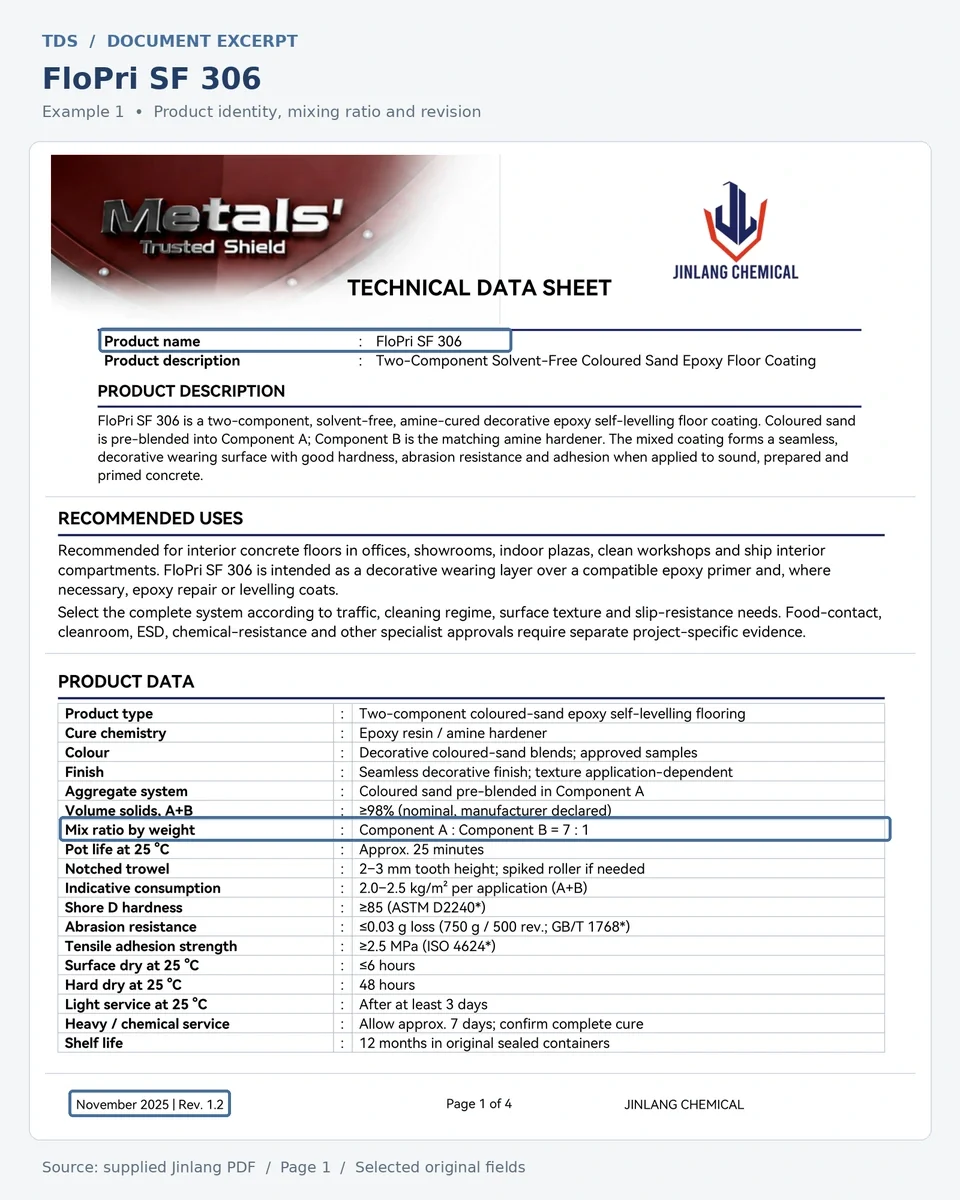
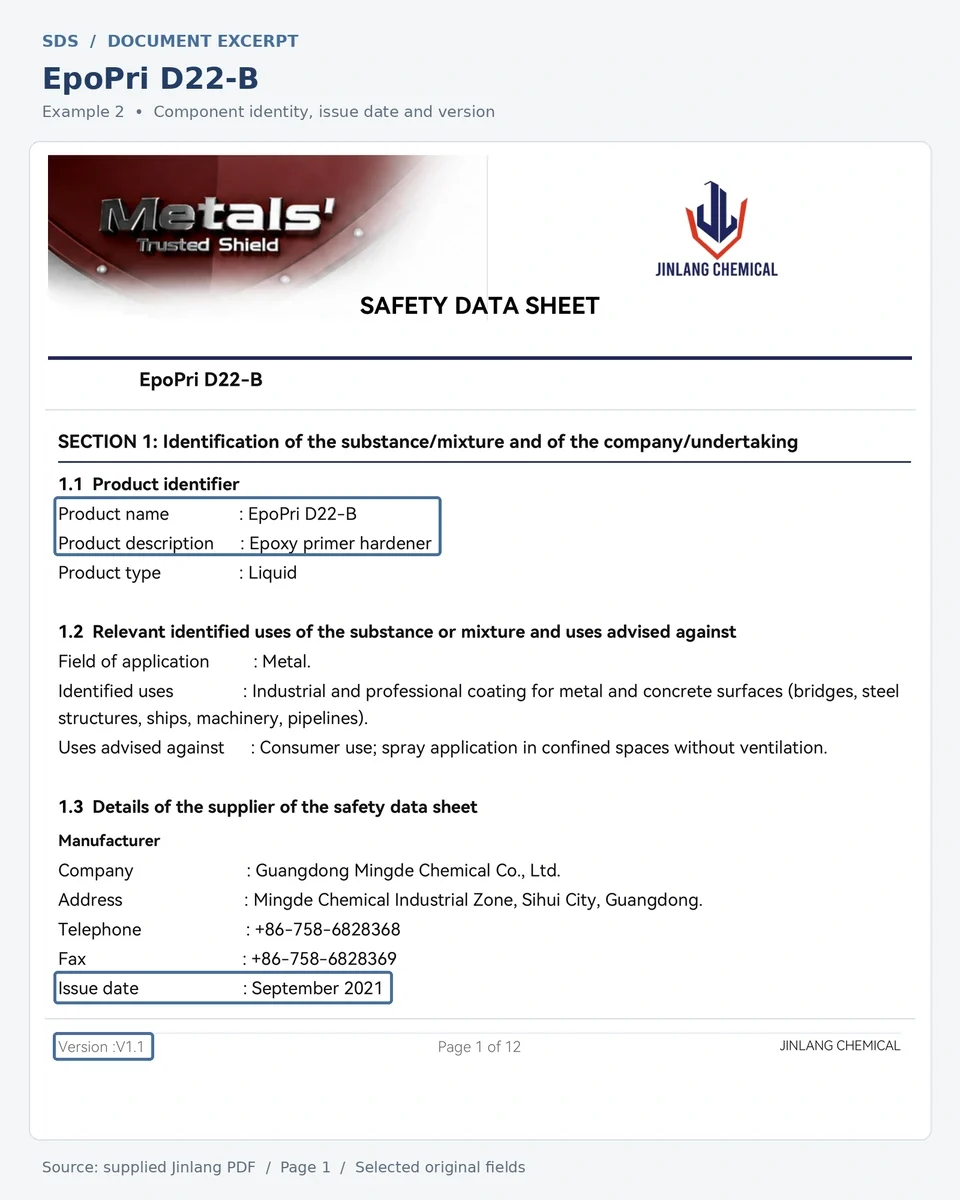
Record the revision date and version of each document, and link them to the supplied product or batch record. Specify the country and required language so the safety information matches the intended market.
Read mixing ratios, coverage and application conditions
Mixing ratio by weight or volume
Two-component coatings have a specified mixing ratio and measurement basis. A weight ratio uses a scale; a volume ratio uses suitable graduated measuring equipment.
For example, a hypothetical 4:1 ratio by weight means 4 kg of Part A for every 1 kg of Part B. The same calculation produces a 1.25 kg mixture from 1 kg of Part A and 0.25 kg of Part B, where partial mixing is permitted. Product densities determine the corresponding volume ratio.
Use the ratio, measurement basis, mixing sequence and permitted batch size stated in the product instructions. Record any specified induction time or approved thinner separately from the A:B ratio.
Coverage and consumption
Check whether the TDS reports theoretical coverage in m²/L, material consumption in kg/m², or consumption at a specified thickness. For metal coatings, identify the Dry Film Thickness (DFT) behind the coverage figure. For flooring, identify the thickness and layer associated with the stated consumption.
A complete order estimate uses the applicable theoretical rate, project area and thickness, together with practical allowances for substrate texture, application method and material losses.
Application and curing data
Locate the approved substrate and preparation requirements, permitted temperature and humidity conditions, application methods, pot life and recoat window. Where supplied, record traffic-release and chemical-exposure times for flooring. For multilayer projects, assemble the compatible products into a separate layer schedule.
Find the relevant SDS sections
Safety data sheets commonly follow the 16-section format associated with the Globally Harmonized System (GHS). The following index helps site teams locate information during procurement, storage and use.
| Task | SDS section |
|---|---|
| Identify the product and supplier | 1 — Identification |
| Review hazard classification and label elements | 2 — Hazards |
| Review ingredient information | 3 — Composition |
| Prepare first-aid procedures | 4 — First aid |
| Prepare fire response | 5 — Firefighting |
| Prepare spill containment and clean-up | 6 — Accidental release |
| Organise storage and handling | 7 — Handling and storage |
| Select exposure controls and personal protective equipment | 8 — Exposure controls and protection |
| Check physical properties and chemical stability | 9 and 10 |
| Review health effects and environmental information | 11 and 12 |
| Arrange waste handling and transport | 13 and 14 |
| Review regulatory and revision information | 15 and 16 |
The applicable regulatory requirements depend on the destination market. For the United States, see OSHA's Hazard Communication Standard. Make the relevant SDS available to staff who handle the coating and use it as part of site training and operating procedures.
Resolve discrepancies before application
Compare the quotation, product labels and technical documents during order review. When a product code, mixing ratio or application parameter differs between records, collect the relevant pages and label photographs. Request a reconciled written instruction for the exact product and components, and distribute that version to the site team before batching or application.
Two additional document questions
Why do some older documents use the term MSDS?
Material Safety Data Sheet (MSDS) is a historical document name. Safety Data Sheet (SDS) is the terminology widely used with the GHS-based format. For procurement, identify the product, revision and format required in the destination market.
When should I request an updated SDS?
Review the applicable SDS when ordering for a new project, changing the supplied product or receiving a supplier revision notice. New hazard information, changes to protective measures and applicable regulatory requirements can trigger document updates.
Download the product documents
Open the Jinlang Download Centre and select the product code. For a 1K coating, collect the TDS and SDS. For a 2K coating, collect the TDS, SDS A and SDS B. Include the safety documents for separately supplied thinners or other ancillary chemicals in the project file.
Download TDS and SDS